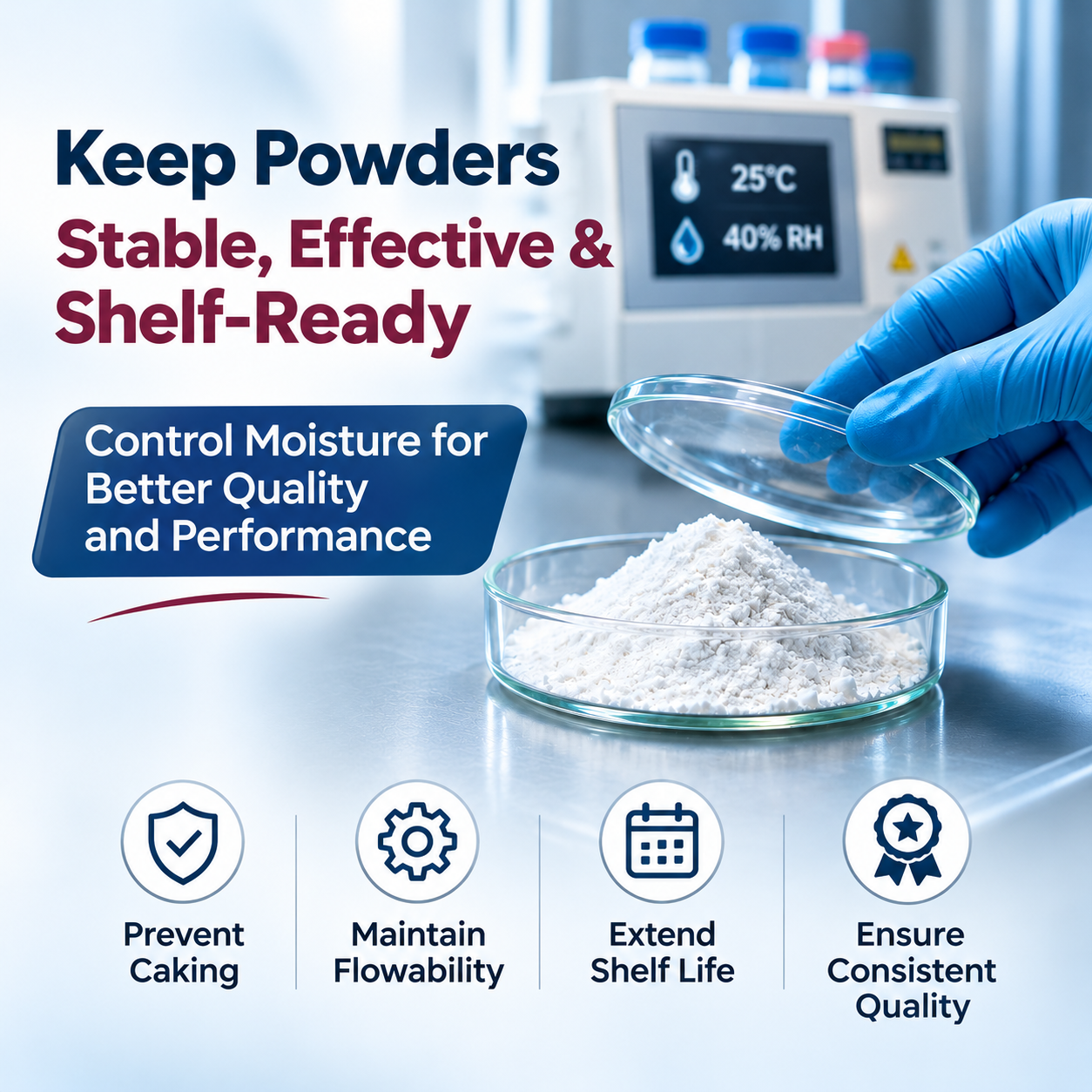
How Moisture Control Affects Oral Powder Stability
A pharmaceutical powder may look perfectly fine after production, but even a small amount of unwanted moisture can affect its quality, performance, and shelf life. From clumping to chemical degradation, moisture exposure can create challenges throughout pharmaceutical manufacturing.
Maintaining oral powder stability is essential for ensuring product quality, consistent performance, and reliable shelf life. Understanding how moisture interacts with pharmaceutical ingredients helps manufacturers prevent formulation problems and maintain product integrity.
But how does moisture affect oral powders, and what steps can manufacturers take to control it?
Why Is Moisture Control Important in Oral Powder Manufacturing?
Moisture is sometimes intentionally used in pharmaceutical processes such as wet granulation. However, uncontrolled moisture exposure can negatively affect the physical and chemical properties of powders.
Many active pharmaceutical ingredients (APIs) and excipients are hygroscopic, meaning they absorb moisture from the surrounding environment.
Effective pharmaceutical moisture control helps maintain suitable conditions during formulation, manufacturing, storage, and packaging.
Without proper moisture management, manufacturers may experience:
- Caking and clumping: Powder particles stick together and form lumps.
- Chemical degradation: Moisture can trigger hydrolysis and other unwanted reactions.
- Poor flowability: Damp powders may not move smoothly through production equipment.
- Dosage variations: Inconsistent powder flow can affect filling accuracy.
- Reduced shelf life: Moisture-related changes can affect product quality during storage.
5 Ways Moisture Affects Oral Powder Stability
1. Chemical Degradation of Active Ingredients
Excess moisture can trigger hydrolysis, a chemical reaction in which water breaks down susceptible compounds.
Certain pharmaceutical ingredients are particularly sensitive to moisture. Exposure may reduce their potency, affect purity, and increase unwanted impurities.
Do you know? Different pharmaceutical ingredients absorb moisture at different rates. Their chemical structure and physical properties determine how sensitive they are to humidity.
2. Changes in Powder Flowability
Moisture can affect how easily powder particles move during manufacturing.
When particles absorb water, liquid bridges may develop between them, increasing adhesion and causing aggregation.
Poor pharmaceutical powder flowability can result in:
- Inconsistent sachet and container filling.
- Powder sticking to equipment.
- Production interruptions.
- Variations in product weight and dosage.
3. Caking and Physical Instability
Caking occurs when powder particles stick together and form larger masses.
It is particularly common in moisture-sensitive formulations. Caked powders can become difficult to handle, measure, process, and dispense.
4. Changes in Dissolution and Reconstitution
Oral powders are often designed to dissolve or disperse in water before consumption.
Moisture exposure during storage can change particle characteristics and promote aggregation. This may affect dissolution time, dispersion, and reconstitution performance.
5. Reduced Shelf Life
Moisture-related changes may develop gradually during storage. Even products that pass initial quality checks can experience physical or chemical changes over time.
Monitoring pharmaceutical product shelf life is therefore essential when developing moisture-sensitive formulations.
Key Factors That Influence Moisture Absorption
Several material and environmental conditions influence how pharmaceutical powders absorb moisture.
| Factor | Effect on Oral Powders |
|---|---|
| Relative humidity | Higher humidity may increase moisture absorption. |
| Temperature | Influences moisture sorption and chemical reaction rates. |
| Ingredient properties | Determines moisture sensitivity. |
| Particle size | Smaller particles generally have greater exposed surface area. |
| Packaging material | Controls exposure to external water vapour. |
| Storage duration | Longer exposure may increase moisture-related risks. |
6 Effective Ways to Maintain Moisture Control
Manufacturers should consider moisture management throughout the production and storage lifecycle.
1. Maintain Controlled Manufacturing Conditions
Production areas should maintain suitable temperature and relative humidity levels. HVAC systems, humidity sensors, and environmental monitoring help reduce unwanted moisture exposure.
2. Test Raw Materials
Evaluate raw materials for moisture content and hygroscopic properties before production. Common testing methods include Karl Fischer titration, loss on drying, and dynamic vapour sorption (DVS).
3. Optimise the Formulation
Suitable excipients can improve powder stability and handling. Depending on formulation requirements, manufacturers may consider protective coatings, encapsulation, and moisture-management excipients.
4. Use Appropriate Drying Methods
Drying helps remove excess moisture introduced during manufacturing. However, drying conditions must be validated to avoid damaging heat-sensitive ingredients.
5. Select Moisture-Resistant Packaging
Packaging provides an important protective barrier against environmental moisture.
Common options include:
- Aluminium foil laminate sachets.
- High-barrier flexible pouches.
- Moisture-resistant containers.
- Suitable blister packaging.
- Desiccant-based packaging systems.
Pro tip: Check the water vapour transmission rate (WVTR) and seal integrity of packaging materials. Good moisture protection depends on the complete packaging system, not just the material itself.
6. Conduct Stability Testing
Accelerated and long-term stability studies help manufacturers understand how formulations respond to different storage conditions.
Note: Moisture acceptance limits should be established according to the specific formulation, applicable pharmacopoeial requirements, and validated product specifications. There is no universal moisture limit for all oral powders.
Quick Facts: Moisture Control at a Glance
- Hygroscopic ingredients absorb moisture from surrounding air.
- Excess moisture can trigger hydrolysis and physical changes.
- Humidity control supports consistent manufacturing conditions.
- Packaging protects moisture-sensitive formulations.
- Stability testing helps establish suitable storage conditions and shelf life.
What Should Manufacturers Check Before Releasing Oral Powders?
A structured quality control process helps identify potential moisture-related problems before products reach the market.
| Quality Check | What to Evaluate |
|---|---|
| Moisture content | Compliance with established specifications |
| Powder appearance | Caking, clumping, or discoloration |
| Flow properties | Consistency during handling and filling |
| Assay and impurities | Active ingredient content and degradation |
| Packaging integrity | Seal quality and moisture protection |
| Stability results | Performance under defined storage conditions |
Building Better Moisture Management Practices
Moisture control should begin during formulation development, not just at the packaging stage.
Manufacturers need to understand ingredient sensitivity, establish suitable environmental controls, select compatible excipients, and validate packaging performance.
Working with an experienced pharmaceutical manufacturing partner can also help businesses evaluate formulation requirements, production processes, and quality standards.
Explore Unicure Remedies to learn more about pharmaceutical manufacturing and related solutions.
Closing Words: Why Moisture Control Matters
Moisture management plays an important role in maintaining oral powder quality. Uncontrolled exposure can affect chemical stability, powder flow, physical appearance, dissolution, and shelf life.
Key Takeaways:
- Moisture affects both the chemical and physical stability of oral powders.
- Hygroscopic ingredients require special handling and storage.
- Controlled humidity supports manufacturing consistency.
- Protective packaging reduces exposure to external moisture.
- Regular quality checks and stability studies support product reliability.
For more information about pharmaceutical manufacturing, visit Unicure Remedies.
FAQs
1. Why is moisture control important in oral powder manufacturing?
It helps prevent chemical degradation, caking, clumping, and changes in powder flowability. Proper control also supports consistent quality and product shelf life.
2. How does humidity affect pharmaceutical powder stability?
High humidity can cause hygroscopic ingredients to absorb water from the air. This may affect powder flow, chemical composition, and physical stability.
3. Which packaging materials protect oral powders from moisture?
Aluminium foil laminates, high-barrier flexible pouches, and suitable moisture-resistant containers are commonly used. The right choice depends on formulation sensitivity and storage requirements.