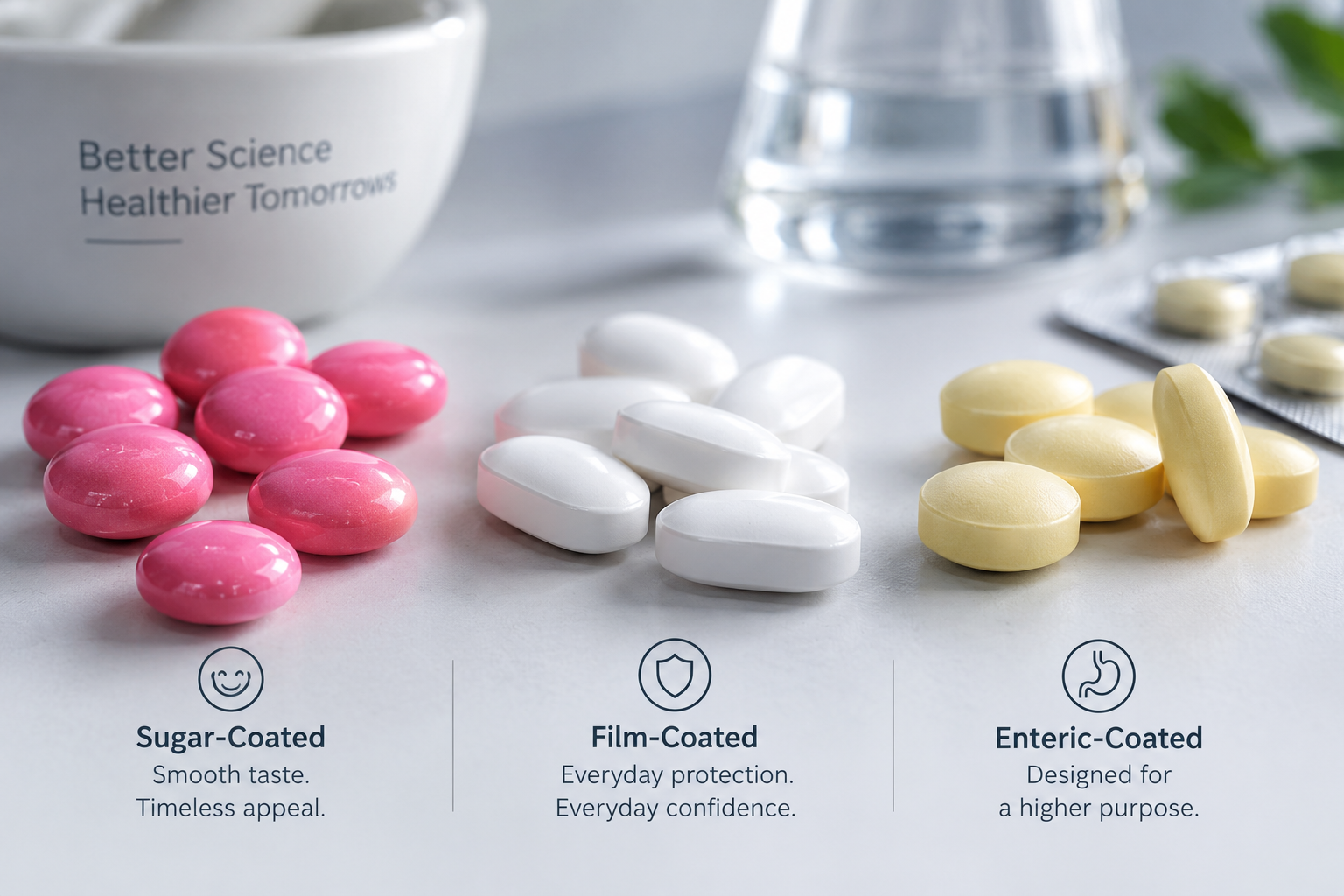
Tablet Coating Explained: Film-Coated vs. Sugar-Coated vs. Enteric-Coated
A tablet may look simple, but its outer layer can influence stability, taste, swallowability, appearance, and even where the medicine is released in the body. That is why tablet coating is an important part of modern pharmaceutical manufacturing, not just a finishing step.
From traditional sugar coatings to thin polymer films and pH-sensitive coatings, each approach serves a different purpose. So, how do you know which one is right for a particular formulation?
Let’s break down the three major options and see how they compare.
What Is Tablet Coating?
Tablet coating involves applying a layer of material around a compressed tablet core. Depending on the formulation, the coating may protect the active pharmaceutical ingredient (API), mask an unpleasant taste or odor, improve the tablet’s appearance, make it easier to swallow, or control when the drug is released.
Modern pharmaceutical tablet coating has evolved significantly. Film coating, in particular, has largely replaced traditional sugar coating for many products because it can provide a thinner, more uniform coating with a more efficient manufacturing process.
Quick Fact: Traditional sugar coating can involve multiple stages, including sealing, sub-coating, smoothing, coloring, and polishing. Film coating streamlined this process by applying a thin polymer-based layer directly to the tablet surface.
Film-Coated Tablets: The Modern Standard
Film-coated tablets are covered with a thin polymer film that can contain polymers, plasticizers, pigments, and other functional ingredients.
The coating is typically sprayed onto rotating tablet cores while controlled airflow helps evaporate the solvent or water. The result is a smooth, relatively thin and uniform layer.
Why are film coatings widely used?
- Improve tablet appearance and product identification
- Mask unpleasant taste and odor
- Improve swallowability
- Reduce chipping, dusting, and surface damage
- Provide additional protection against environmental factors
- Support branding through color and finish
- Enable certain modified-release applications when appropriate polymers are used
Pro Tip: Film coating is not automatically the right choice simply because it is faster. The polymer, coating weight, formulation, process conditions, and desired drug-release profile all need to be considered before selecting a coating system.
Sugar-Coated Tablets: Traditional but Still Relevant
Sugar-coated tablets use multiple layers containing sucrose-based materials, colorants, and polishing agents. The process produces a smooth, rounded and glossy tablet with strong taste-masking properties.
The major drawback is size and processing time. Traditional sugar coating adds significant weight and bulk to the tablet and requires several processing stages.
However, it has not disappeared completely. Sugar coating can still make sense when a particular appearance, taste profile, or traditional product design is important.
Note: Modern sugar-film systems can combine some of the visual characteristics of traditional sugar coating with the more streamlined processing associated with film coating.
Enteric-Coated Tablets: Designed to Wait
Enteric-coated tablets are different because their coating has a functional job beyond appearance and protection.
An enteric coating uses pH-dependent polymers designed to resist the acidic environment of the stomach and dissolve at the higher pH found further along the gastrointestinal tract, generally in the small intestine.
This approach can be useful when:
- The API is sensitive to stomach acid
- The drug may irritate the stomach
- Delayed drug release is required
- Delivery to the intestinal environment is preferred
Enteric coatings may use materials such as methacrylic acid copolymers, hypromellose phthalate, or polyvinyl acetate phthalate.
Film vs. Sugar vs. Enteric Coating: At a Glance
| Feature | Film Coating | Sugar Coating | Enteric Coating |
|---|---|---|---|
| Main purpose | Protection, appearance, taste masking | Taste masking and appearance | Delayed release and gastric protection |
| Coating thickness | Thin | Relatively thick | Formulation-dependent |
| Tablet size impact | Low | Higher | Usually low to moderate |
| Taste masking | Good | Excellent | Good |
| Stomach resistance | Usually no | Usually no | Yes |
| Release profile | Usually immediate, but can be modified | Generally immediate | Delayed |
| Processing | Relatively efficient | Multi-stage | Controlled and formulation-specific |
| Typical use | Most modern coated tablets | Traditional or specialized products | Acid-sensitive or GI-sensitive formulations |
Which Coating Should Manufacturers Choose?
There is no universal winner. The right choice depends on the API, formulation, target release profile, stability requirements, patient needs, manufacturing process, and regulatory requirements.
For a conventional tablet that needs better appearance, swallowability, taste masking, and protection, film coating may be the practical choice.
For a formulation where a distinctive glossy appearance and strong taste masking are priorities, sugar coating can still have a role.
For products requiring protection from gastric acid or delayed release, an enteric system is usually the more appropriate approach.
The manufacturing capability matters too. Modern coating equipment can support film, sugar, and enteric applications, with process parameters tailored to the product and scale.
Why Coating Quality Matters
A coating is only effective when it performs consistently across the batch. Uneven application, poor adhesion, cracking, peeling, or inadequate drying can affect tablet appearance and potentially its performance.
That makes process control critical. Manufacturers need to manage factors such as spray rate, inlet air conditions, tablet movement, coating formulation, drying, and equipment settings.
For pharmaceutical manufacturers looking for reliable production capabilities, Unicure provides pharmaceutical manufacturing solutions across general tablets and other oral dosage forms.
Do You Know? Film coating is not limited to making a tablet look better. Depending on the polymer system selected, coatings can also be engineered for moisture protection, taste masking, immediate release, or modified drug release.
Summary: The Coating Is More Than a Finish
Tablet coating plays a functional role in modern drug manufacturing.
Film coating is widely used for efficient protection, appearance, swallowability, and taste masking. Sugar coating remains useful where strong taste masking and a traditional glossy appearance are desired. Enteric coating is selected when the formulation needs to resist stomach conditions and release the drug later in the gastrointestinal tract.
The key is not choosing the most advanced coating. It is choosing the coating that matches the formulation and its intended performance.
Key Takeaways
- Film coating provides a thin, uniform layer and is widely used in modern tablet manufacturing.
- Sugar coating offers strong taste masking and a distinctive glossy appearance but adds more bulk and processing steps.
- Enteric coating is designed for delayed release and protection against gastric conditions.
- Coating selection depends on the API, dosage form, stability, release profile, patient requirements, and manufacturing process.
- Consistent coating application and process control are essential for reliable product quality.
For pharmaceutical manufacturing and dosage-form requirements, explore Unicure to learn more about its manufacturing capabilities.
FAQs
1. What is the main purpose of coating a tablet?
Tablet coating can improve appearance, mask unpleasant taste or odor, make tablets easier to swallow, protect the formulation, and, in some cases, control drug release.
2. Are film-coated and enteric-coated tablets the same?
No. An enteric coating is a specialized type of film coating designed to resist stomach acid and delay drug release until the tablet reaches a suitable intestinal environment.
3. Why is sugar coating less common today?
Traditional sugar coating requires multiple processing stages and creates a thicker, heavier tablet. Modern film-coating technologies can achieve many of the desired benefits more efficiently, making film coating a common choice for contemporary pharmaceutical products.