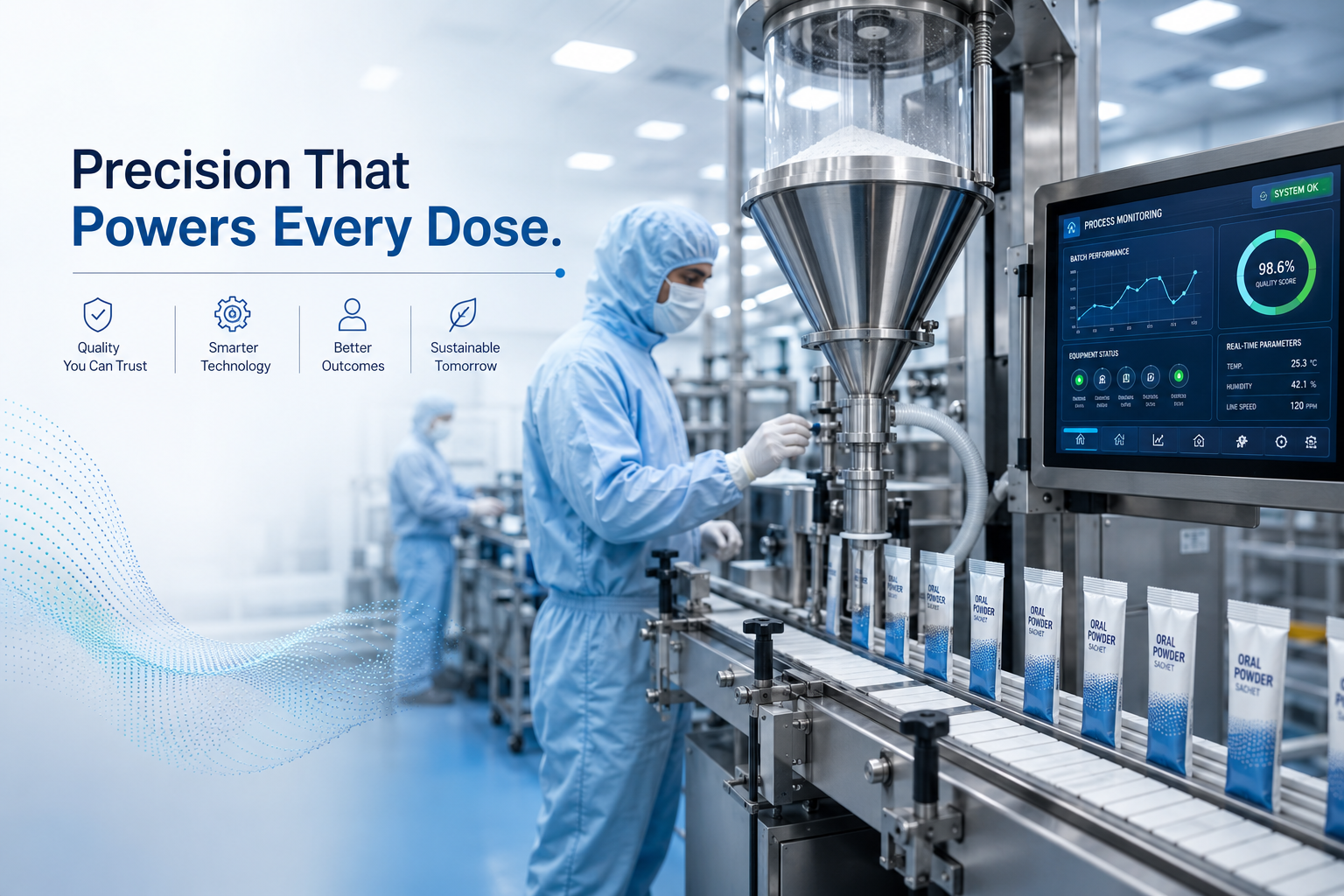
Trends in Oral Powder Manufacturing for 2026
The pharmaceutical industry is moving beyond traditional powder production. In 2026, oral powder manufacturing is becoming smarter, more precise, and increasingly patient focused. From advanced formulation technologies to AI-supported quality control, manufacturers are adopting innovations that improve product quality, regulatory compliance, and production efficiency.
One trend leading this transformation is the growing demand for oral powder manufacturing. Pharmaceutical companies, healthcare providers, and government procurement agencies are seeking reliable manufacturing partners capable of producing stable, easy-to-use, and high-quality oral powder formulations for global markets. Modern manufacturing is now driven by continuous process improvements, digital monitoring, and patient convenience. Recent industry guidance also highlights the increasing adoption of continuous manufacturing and advanced process control to improve quality and operational efficiency.
Why Oral Powders Continue to Gain Popularity
Oral powders remain one of the most versatile pharmaceutical dosage forms. They offer several advantages:
- Faster dissolution compared to many solid dosage forms
- Flexible dosing options
- Better suitability for pediatric and geriatric patients
- Convenient packaging in sachets, sticks, and bottles
- Longer shelf life when properly formulated
As healthcare becomes increasingly patient-centric, manufacturers are focusing on formulations that improve taste, stability, and ease of administration.
Top Oral Powder Manufacturing Trends in 2026
1. Growing Demand for pharmaceutical oral powder manufacturer
Companies are increasingly partnering with experienced pharmaceutical oral powder manufacturer organizations that offer complete development, scale-up, manufacturing, packaging, and regulatory support.
Manufacturers are expected to provide:
- GMP-compliant facilities
- Flexible batch sizes
- Faster product development
- Global export capabilities
- Complete documentation support
2. Continuous Manufacturing is Becoming Mainstream
Traditional batch manufacturing is gradually being complemented by continuous manufacturing technologies.
Benefits include:
- Better batch consistency
- Reduced production downtime
- Lower manufacturing waste
- Faster product release
- Improved process control
Advanced inline monitoring systems help manufacturers detect quality deviations in real time instead of waiting until the end of production.
Pro Tip: When selecting a manufacturing partner, ask whether they use real-time process monitoring and modern quality control systems. These technologies significantly reduce production variability.
3. Better Taste Masking Technologies
Consumers expect medicines to be easier to take. Manufacturers are investing in advanced taste-masking technologies that improve patient compliance without affecting drug performance.
This is particularly important for:
- Pediatric formulations
- Nutraceutical powders
- Antibiotic powders
- Electrolyte formulations
4. Smart Packaging Solutions
Demand for oral powder sachet manufacturer services continues to grow because unit-dose packaging offers:
- Improved dosing accuracy
- Better moisture protection
- Longer product stability
- Easy transportation
- Greater patient convenience
Modern stick packs and sachets are becoming preferred packaging formats across many therapeutic categories.
Do You Know? Single-dose sachets also reduce the risk of contamination because patients use the exact quantity required for each dose.
5. AI and Digital Quality Monitoring
Artificial Intelligence is gradually supporting pharmaceutical manufacturing by improving:
- Process monitoring
- Predictive maintenance
- Equipment performance
- Production planning
- Documentation accuracy
While AI adoption remains carefully regulated, manufacturers are increasingly using digital tools to support GMP operations and improve manufacturing efficiency.
Comparison of Traditional vs Modern Oral Powder Manufacturing
| Manufacturing Area | Traditional Approach | 2026 Approach |
|---|---|---|
| Process Control | Manual monitoring | Digital monitoring & PAT |
| Production | Batch-based | Continuous & hybrid manufacturing |
| Quality Checks | End-product testing | Real-time quality monitoring |
| Packaging | Bottles only | Sachets, stick packs & bottles |
| Documentation | Paper-heavy | Digital records & automation |
6. Focus on Powder Flow and Blend Uniformity
One major challenge in powder manufacturing is maintaining consistent blend uniformity. Manufacturers are improving powder formulation development by optimizing:
- Particle size
- Powder flow
- Moisture control
- Blend homogeneity
- Excipient compatibility
Better powder engineering minimizes segregation and helps maintain consistent dosage across every batch. Industry experts are also highlighting advanced control strategies and improved analytical technologies to strengthen uniformity during continuous manufacturing.
Quick Fact: Even minor differences in powder flow can affect filling accuracy, product consistency, and manufacturing efficiency.
7. Sustainability is Influencing Manufacturing
Environmental responsibility is becoming a competitive advantage. Manufacturers are investing in:
- Energy-efficient production lines
- Reduced material waste
- Sustainable packaging materials
- Lower water consumption
- Optimized production planning
These improvements help pharmaceutical companies meet both regulatory and sustainability goals.
Note: Sustainability does not only reduce environmental impact. Efficient manufacturing often lowers operational costs while improving overall productivity.
Choosing the Right Oral Powder Manufacturing Partner
Selecting the right manufacturing partner involves much more than comparing prices. Look for companies that provide:
- Contract pharmaceutical manufacturing
- GMP-certified production
- Regulatory documentation
- Flexible packaging options
- Experienced formulation scientists
- Stability testing support
- Export capabilities
- Reliable quality systems
An experienced manufacturer can simplify product development while helping brands reach the market faster.
Wrapping Up
The future of oral powder manufacturing is being shaped by digital technologies, smarter quality systems, patient-friendly formulations, and sustainable production practices. Continuous manufacturing, AI-assisted monitoring, improved taste masking, and advanced packaging are setting new industry standards in 2026.
For pharmaceutical brands looking to launch or expand oral powder products, partnering with a manufacturer that combines technical expertise, regulatory compliance, and modern manufacturing capabilities can make a significant difference in product quality and long-term success.
Key Takeaways
- Oral powder manufacturing is evolving through automation and digital quality control.
- Continuous manufacturing improves consistency, efficiency, and product quality.
- Advanced taste masking enhances patient compliance.
- Smart sachet packaging improves stability and convenience.
- AI-assisted monitoring supports more efficient GMP manufacturing.
- Sustainability is becoming an essential part of pharmaceutical production.
- Choosing an experienced pharmaceutical oral powder manufacturer helps accelerate successful product commercialization.
FAQ's
1. Why are oral powders becoming more popular in pharmaceuticals?
Oral powders provide flexible dosing, faster dissolution, improved patient convenience, and excellent stability, making them suitable for various therapeutic applications.
2. What should companies look for in an oral powder manufacturing partner?
Evaluate GMP compliance, formulation expertise, packaging capabilities, quality systems, regulatory support, scalability, and global manufacturing experience.
3. What are the biggest oral powder manufacturing trends in 2026?
The leading trends include continuous manufacturing, AI-supported quality monitoring, advanced taste masking, smart packaging, sustainable production, and improved powder engineering for better consistency.